
They talked about us:

Italy at its best
Discover the beauty of Italy, get insider tips and travel advice.
This is the start of a mysterious and fascinating trip: a voyage across more than 20 centuries of creativity through which art and history intertwine, telling the story of what human ingenuity has created through the ages.
This is the start of a mysterious and fascinating trip: a voyage across more than 20 centuries of creativity through which art and history intertwine, telling the story of what human ingenuity has created through the ages.
Here you can discover the incredible treasure that Italy holds, a true treasure trove of art, history, and unparalleled wonders. We are delighted to accompany you on a sensory and emotional journey through the most important tourist destinations, where art blends with nature, creating unforgettable experiences.
Discover our products designed for tourists
Not far from the Forum, we can see the most important thermal complex of Ostia. The Forum's thermal baths were built starting from 150 A.D., under Antonino Pio, and transformed several times until the fifth century. The system was designed according to the optimal exposure considering the afternoon use: as a matter of fact, the various rooms were facing south and arranged in a set of steps in order to make the most of the light and heat of the sun.
The main building, dating back to the first construction, included the frigidarium (cold water swimming pool), an elliptical sudatorium (sweating room), the tepidarium (warm water swimming pool) and the calidarium (hot water swimming pool). The rooms were characterized by their original and varied shape, associated with their different functions. A narrow corridor led to an open space, colonnade, which served as a gym.
The entire complex was warmed up in the basement. There was also a cistern from which, thanks to a wheel with a diameter of about ten meters the water rose to the surface.

Photo gallery: pictures of Ancient Ostia
 Via delle Corporazioni
 Baths of Neptune
 Public Toilets
 Ancient Ostia
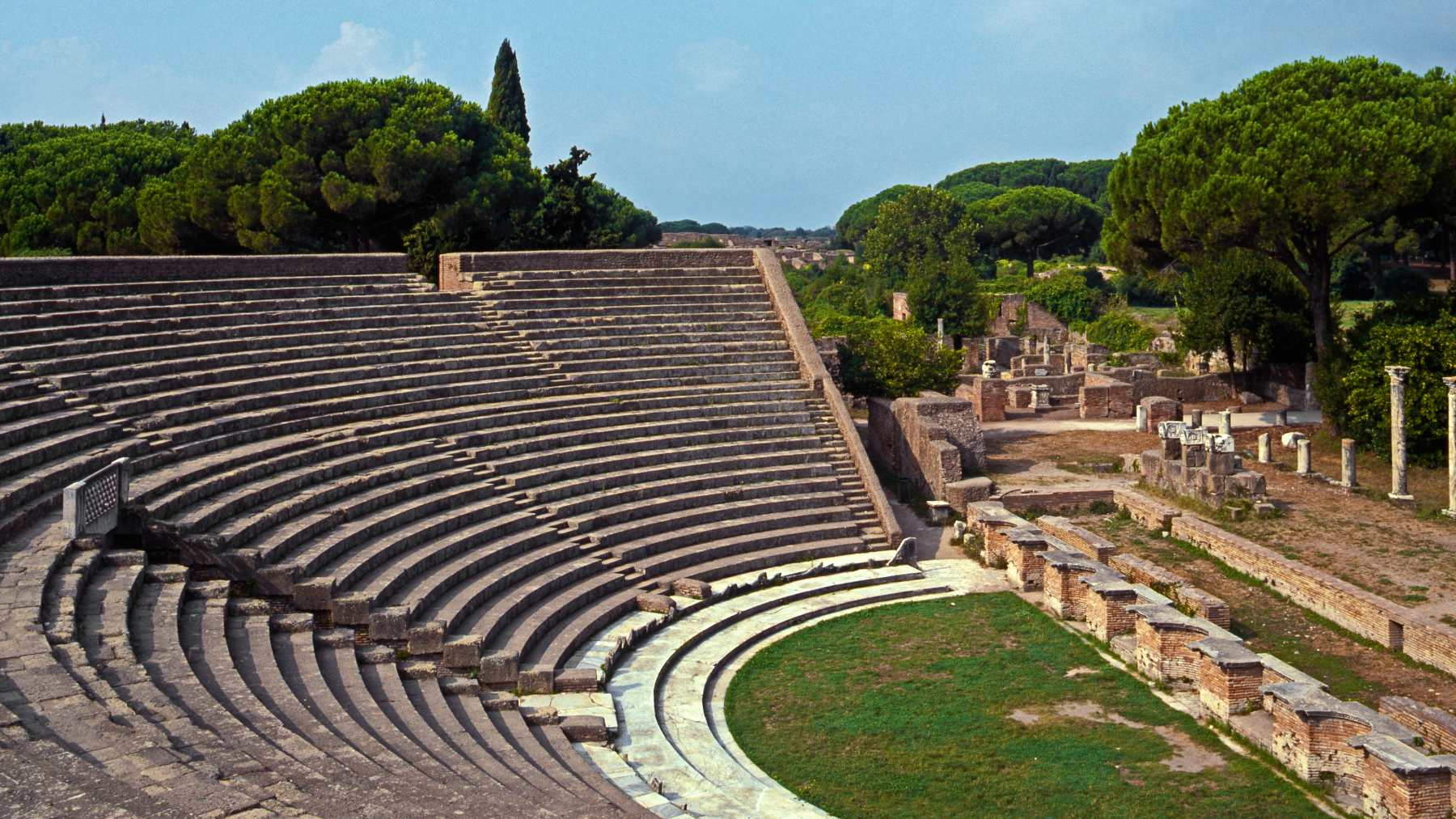 Roman Theatre
 Capitolium Temple
 Ancient Ostia
 Baths of Neptune
 Ancient Ostia
 Ancient Ostia
 Forum Baths: Frigidarium
 Domus di Amore e Psiche
Roman Theatre
Along the decumanus maximus, one of the main streets of the city's development, you will come across the outer curve of the cavea of the Theatre, built under Augustus (end of the first century BC) and then rebuilt using bricks in 196 - the current outer ring, made of bricks, is a modern reconstruction, as are the steps of the cavea, built for the Universal Exhibition of Rome in 1942.
Walls of the original construction, from the time of Augustus, are still visible along the side corridors, on either side of the orchestra. The theatre included two tiers of steps and could accommodate up to 2500 spectators. The capacity was further increased with the addition of a third tier of steps - at the time of Septimius Severus and Caracalla - and an upper loggia.
Caupona di Alexander
A splendid fountain dating back to the time of Hadrian, can also be found on the Decumanus. The portico above the pool continued to the so-called Caupona (tavern) by Alexander Helix, whose name originates from an inscription on the floor. From the erotic mosaics dating to the third century, it is assumed that it was a pleasure house.
Capitolium temple
At the meeting point between the two main streets of the city, the cardus maximus and the decumanus maximus widens the Forum, the main square that housed the most important religious and civil buildings. The current shape of the forum, flanked by porticoes with splendid Corinthian columns, dates back to the Hadrian era (117-138).
The temple was supposed to reach a height of about twenty metres. It was probably covered in marble - the holes in the masonry for anchoring the slabs are still visible.
On the opposite side of the forum was the Temple of Rome and Augustus, of which only the foundations remain today, while on the long sides of the square were facing the basilica - a building that, in Roman times, was intended for the administration of justice and not for religious practices - and a series of arcades.
In Republican times Ostia was Rome's main commercial port and a military base defending the coastline and the mouth of the Tiber. The port continued to flourish under the Empire, despite the development, of Portus, a new port slightly to the northwest, in the 2nd century AD. Ostia's decline began in the 4th century, when a reduction in trade was combined with the gradual silting up of the harbour.
Then malaria became endemic in the area and the city, whose population may have been nearly 100,000 at its peak, was totally abandoned. Buried for centuries by sand, the city is remarkably well preserved. The site is less spectacular than Pompeii or Herculaneum because Ostia died a gradual death, but it gives a more complete picture of life under the Roman Empire.
People of all social classes and from all over the Mediterranean lived and worked here.
They talked about us: