


They talked about us:

Italy at its best
Discover the beauty of Italy, get insider tips and travel advice.
This is the start of a mysterious and fascinating trip: a voyage across more than 20 centuries of creativity through which art and history intertwine, telling the story of what human ingenuity has created through the ages.
This is the start of a mysterious and fascinating trip: a voyage across more than 20 centuries of creativity through which art and history intertwine, telling the story of what human ingenuity has created through the ages.
Here you can discover the incredible treasure that Italy holds, a true treasure trove of art, history, and unparalleled wonders. We are delighted to accompany you on a sensory and emotional journey through the most important tourist destinations, where art blends with nature, creating unforgettable experiences.
Discover our products designed for tourists


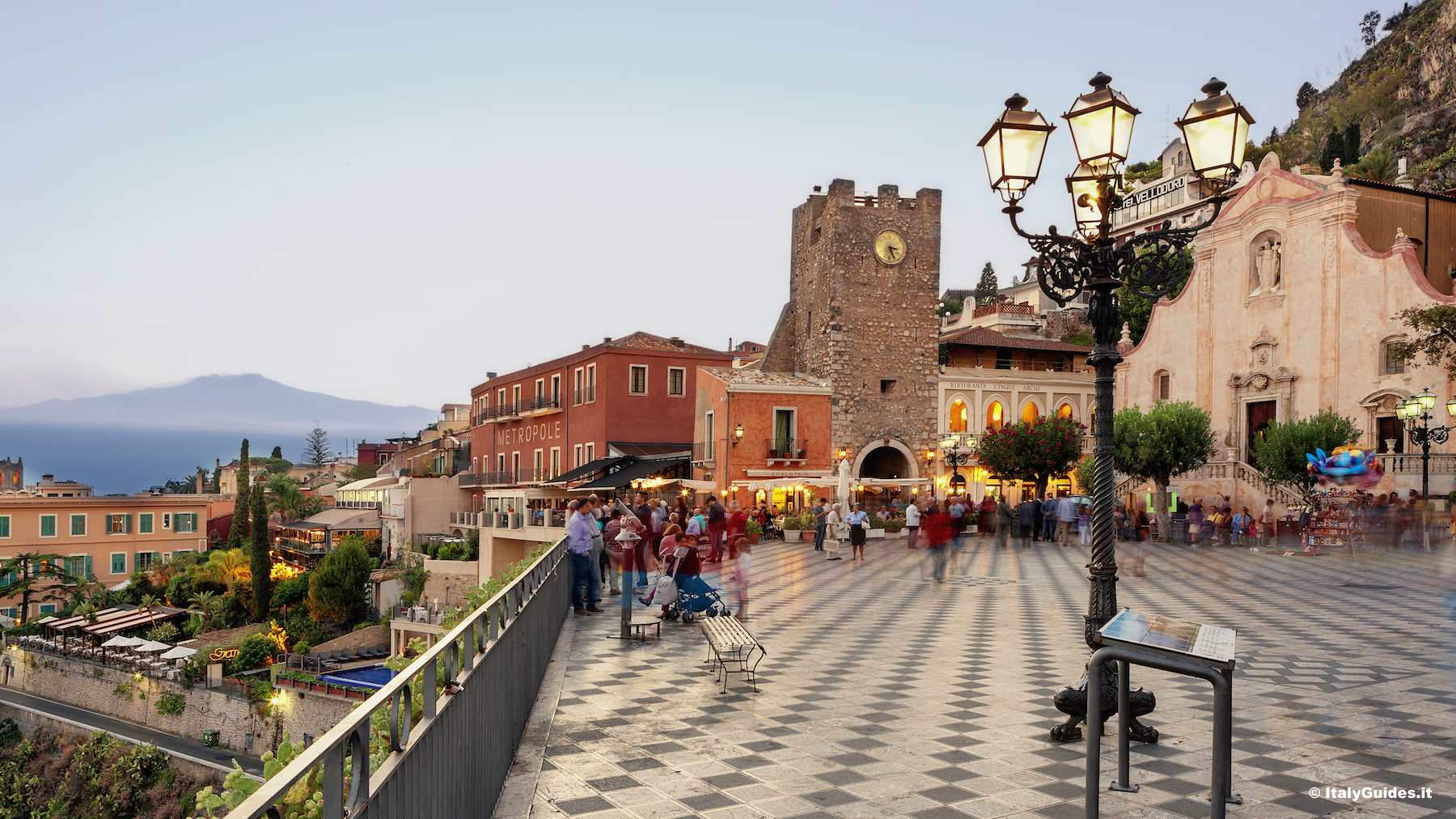

IX Aprile Square
The charming centre of a delightful Sicilian town, Piazza IX Aprile, with its characteristic black and white paving, affords a breathtaking view of the azure Ionian Sea and of the Mount Etna.
On the other side of the square stands the former Gothic St. Augustine's Church and the Seventeenth Century Church of St. Joseph overlooks the piazza from the top of a flight of steps.
The square also leads to the oldest part of Taormina through the Porta Di Mezzo upon which stands the Clock Tower.

Duomo Square
The compact and perfectly picturesque Piazza Duomo, complete with its own bar and fountain, is the ideal spot to relax whilst on holiday wanderings.
A flight of steps leads to the Palazzo Ciampoli. Though bombed during the second world war and almost completely destroyed, it did not loose its characteristic late medieval façade, and certain Spanish Catalan elements of its structure. The palazzo is now converted into a hotel.
To the right of the Piazza is the Floresta house. Originally built in the Fourteen and Fifteen Hundreds, despite various modifications over the years it has maintained several parts of its original structure.
The Palazzo Municipale (Town Hall) is slightly more recent, dating from the Sixteen Hundreds. The baroque stone fountain at the centre of the piazza is crowned with a mythical figure, half bull half woman: the symbol of Taormina.
The Duomo - the Cathedral - on the piazza, is built on a place of worship dating from the Thirteenth Century and was dedicated to St Nicholas. However, the church was completely reconstructed in the Fifteenth and Seventeenth Centuries and restored in the Seventeen Hundreds.
The portal contains elements of every refurbishment it has undergone, which is yet another illustration of the way history has been blended and documented in architecture over the centuries. Furthermore, the interior of the church, with its three naves, bears testimony to both the Renaissance and Baroque eras.
The Alcantara Gorges are deep incisions in volcanic rocks and cliffs, caused by the eruptions of Mount Etna. They lie a short distance from Taormina, where the mountain has been literally split and is now part of the course of a river. The water choruses over grey stone, now covered by dense vegetation climbing through the numerous crags and crevices in the rock.
The less intrepid traveller can reach the gorges with a lift, but the more adventurous can descend into the gorge on foot, where the river can be followed for about 150 meters through mysterious shadowy rocky bends along the walls of the rock-face.
Second in size only to the Theater in Syracuse, the Greek Theater in Taormina is one of the largest ancient theaters in Sicily.
Though originally built in the Hellenistic era, it was completely reconstructed by the Romans and used for gladiatorial shows. The theater is situated at the very top of a hill, levelled for the purpose, using the natural incline of the valley for the "cavea": the auditorium seating.
The backdrop view would doubtless have added splendid dramatic impact to past productions.
The remains of a small temple stand on the side of the theater. Remnants of an arcade, once leading to the theater, stand at the top of the auditorium. Scenery consisted of nine columns, raised and placed in their original positions during the theater's restoration in the Eighteen Hundreds.
The majestic panorama, combined with a spectacular view of Etna and the Calabrian mountains, renders this hollowed out hill a natural stage, as well as a stage for natural beauty.
History, facts and travel tips about Taormina
The climate is a dream, its position, perfect panoramas, monuments and luxurious flora and fauna render Taormina a location admired by all who visit it. The city lies on a terrace, with a view of the ancient Amphitheater against a backdrop of citrus groves with Mount Etna engulfed in the glory of the Ionian Sea beyond.
Taormina's genesis and early history began with the Greeks who founded and named the town in 358 B.C.; travelling to Naxos and settling there had later extended their territory to Taormina. Desired for its strategic position overlooking the sea and valley, it was seized by the Romans, and later fell into Byzantine hands. The Arabs, on their arrival, enriched the surrounding countryside, building an efficient irrigation system for crops, ensuring Taormina's desirability and verdant beauty.
During the Sicilian Struggle for freedom from the French, and the Sicilian Vespers uprising, Taormina gave its support to the Spanish Aragon family, who, once established in Sicily, rewarded the city richly. Various Spanish and Aragon ruling families funded the building of churches and great houses in the charming Gothic Romanesque style.
Taormina has proved a source of inspiration to novelists and writers throughout the centuries from Ovid to Goethe and D.H. Lawrence who, whilst in Taormina wrote "Lady Chatterley's Lover", and based various aspects of his novels on his experiences in the city. Goethe praised Taormina in his "Italian Journey", to such a degree that it became an integral part of the Grand Tour, upon which fashionable English gentlemen and intellectuals embarked for purposes of education and refinement in the 1800's. Basking in its new found international popularity, Taormina expanded with the creation of numerous new hotels, many of which are still thriving, as Taormina's popularity has not waned.
Taormina had graduated to status and became an exclusive, high-class haunt, frequented by an array of artists and personalities. The list is somewhat inexhaustible, but to name a few: Alexander Dumas, Johannes Brahms, Gustav Klimt, Richard Wagner, Oscar Wilde, Truman Capote, John Steinbeck, Ingmar Bergman, Francis Ford Coppola, Leonard Bergman, Marlene Dietrich, Greta Garbo, Federico Fellini, Cary Grant, Gregory Peck, Elizabeth Taylor, and Woody Allen.
During the Second World War, Taormina was subjected to bombing raids by the allies who invaded Sicily in 1942, shortly before the fall of Mussolini. Damage inflicted in the town included destruction of part of the ancient (and very beautiful) amphitheater and St. Dominic's church. However, much of what had been damaged was restored soon after the war and Taormina appears to have survived relatively unscathed.
During the 1960's something of the city's exclusivity declined. The quantity of cement accumulated, infringing on the pleasant and peaceful greenery and began to spread indiscriminately. The beaches became more oriented toward mass tourism, populated by salesmen, speculators and low budget hoteliers. Thus, something of its ancient peace and dignity departed.
Today however, a tasteful balance has been struck between the affluent refinement and luxury of yesteryear and the requirements of the more modest modern wayfarer. Thus Taormina's reputation as a a city infused with poetic beauty and history with views of splendour in plenty, remains true for every traveller.
They talked about us: